
Italy is one of the most visited countries in the world, but many travelers assume it is always expensive. In reality, traveling in Italy can be surprisingly affordable if you know a few local habits and plan your trip carefully.
This guide is written by a local Italian and a savings enthusiast, so the tips come from real experience. I will explain how to reduce costs before and during your trip: when to book, how to move between cities cheaply, how restaurants work, and how to avoid common tourist traps.
The tips are especially useful for first-time visitors who want to enjoy Italy without spending more than necessary, but I’m sure even people who visited Italy already will discover something useful.
Planning your trip to Italy
Saving money in Italy often starts before the trip even begins.
1. Choose the right travel period
Prices for flights and hotels vary significantly during the year. The most affordable months are usually March–May and September–November. These periods offer milder weather and lower tourist demand.
August is usually the most expensive month because it is the main holiday period for Italians and European travelers and it might be very hot and tiring if you plan to visit historical cities.
Avoid peak travel weeks: prices rise sharply during major holidays such as Easter, 25th April, 1st May, 1st June, Christmas, and New Year.
2. Book in advance
Booking early can reduce travel costs considerably.
Flights are usually cheaper when booked around two to four months before departure. High-speed trains often offer discounted tickets one or two months in advance, while hotels in popular cities should ideally be reserved two or three months before arrival.
Flights
The best website for comparing flights is still the trusty Skyscanner. Not only does it allow you to quickly view results from all major international airlines, but it also helps you identify cheaper travel dates, set up price alerts, and filter out inconvenient flight times or airlines you prefer not to use.
It displays both the airline’s official fare and prices offered by online travel agencies and resellers such as GoToGate, Lastminute.com or Trip.com.
Accommodation
Have a look on Hotiday an Italian platform that guarantees the lowest prices on a (small) number of hotels and apartments in Europe. Use TuttoCashback code for an additional 5% discount: HELLOHOTIDAY5
3. Use cashback platforms when booking
Many travelers do not realize they can get money back when buyng online services. Cashback platforms return a small percentage of the purchase after you complete a booking.
Two platforms commonly used in Europe are Beruby and TopCashback.
These platforms provide cashback for hotel reservations, online travel services, shopping before your trip.
The process is simple: access the booking website through the cashback platform, complete the purchase, and receive part of the spending back later.
Beruby also offers gift cards of several brands with immediate cashback that you can use online or in real shops.
4. Booking accommodation the smart way
Accommodation is usually the largest travel expense.
Choose the location carefully
A cheap hotel far from the city center may require expensive taxi rides or long transport times. Staying near metro lines or major train stations often saves money overall.
Understand the tourist tax
Main Italian cities charge a small city tax per night, usually between €1 and €7 depending on the accommodation category. This fee is typically paid directly at the hotel.
Compare hotels and apartments
Apartments may be more convenient for longer stays or families. They also allow you to cook occasionally or order delivery food and reduce restaurant expenses.
Check cancellation policies
Flexible cancellation options are useful if travel plans change, but they cost more.
Getting around Italy for less
Italy has a large transportation network, but prices vary depending on the type of service.
Trains
High-speed trains are the fastest way to travel between major cities such as Rome, Florence, Milan, and Venice. However, tickets are much cheaper when purchased early. Regional trains are slower but often significantly cheaper.
Trenitalia and Italo are the two main train brands, the latter serving only high-speed routes.
Long-distance buses
Bus companies often offer lower prices than trains, especially for longer routes or last-minute trips. The main companies operating in Italy are Flixbus, Blablacar Bus and Itabus.
Both train and buses routes and prices can be checked and compared on platforms such as Omio, Trainline and Trainpal.
City transportation
Most cities offer daily or multi-day transport passes that can be cheaper than buying individual tickets. Many public transport systems in big cities now allow contactless payments with credit cards or smartphones.
Taxi tips
Always use official taxis and make sure the taximeter is active. Avoid accepting rides from drivers who approach tourists directly near train stations or airports.
Taxi apps are generally more convenient than taxi as price is known from the beginning so there’s no risk of scams, and there’s no need to speak italian, simplifying communication. Uber and Free2move are the two main apps covering most of the main italian cities.
Walk whenever possible
Italian city centers are compact, walking saves money and gives you a better feel for the city.
Museums and attractions: how to save on tickets
Italy is famous for its museums, archaeological sites, and historic landmarks. However, entrance tickets to major attractions can add up quickly, especially in cities such as Rome, Florence, and Venice. Planning ahead can help reduce both costs and waiting time.
Book tickets online in advance
Many popular attractions have long lines, particularly during the high season. Booking tickets online allows you to secure your visit time and often skip ticket office queues.
Several international platforms allow visitors to compare prices, find guided tours, or purchase skip-the-line tickets, the main ones are GetYourGuide, Klook, Tiqets and Musement. These platforms sometimes offer discounted tickets, bundled attractions, or guided tours that may be cheaper than purchasing services separately.
Consider city passes carefully
Many Italian cities offer tourist passes that include museum entries and public transport. These can be convenient but are not always the cheapest option. They are usually worthwhile only if you plan to visit several attractions in a short time. Check if websites such as Turbopass o Go City provides convenient city passes.
Take advantage of free museum days
Many state museums in Italy offer free admission on the first Sunday of every month. While this can save money, it also tends to attract large crowds, so visiting early in the day is recommended.
Look for smaller museums
Italy has thousands of museums, many of which are much less crowded and more affordable than the most famous attractions. Visiting smaller museums can offer a more relaxed experience while keeping your travel budget under control.
Free walking tours
GuruWalk lists walking tours of many city centers around Italy. These tours doesn’t have a fixed price. Participants are free to give a tip at the end of the tour based on how much they enjoyed it. This “pay-what-you-want” system makes it a budget-friendly way to explore cities like Rome, Florence, Venice, Milan, and Bologna, while learning from local guides who know the hidden corners and stories that typical tourist maps miss.
Eating well without overspending
Italian food is famous worldwide, but eating in tourist areas can be expensive if you are not careful.
Avoid tourist restaurants
Restaurants directly next to major attractions often charge higher prices. Signs of tourist-oriented places include menus with photos, aggressive invitations from staff outside, and unusually large menus in many languages.
Understand the “coperto”
Italian restaurants often charge a small fee called “coperto.” This covers bread and table service and usually costs between €1 and €3 per person, but in high-level restaurants or main tuoristic cities can be even higher. Always check or ask in advance to avoid surprises.
Tipping culture
Unlike in some countries, tipping is not mandatory in Italy. Service is typically included in the price. Leaving small change or rounding up the bill is considered polite but not required and locals never tips.
Lunch menus
Many trattorias offer cheaper “pranzo” (lunch) menus from Monday to Friday.
Look for local food options
Affordable meals can often be found at bakeries, “pizza al taglio” shops (take away pizza by the slice), local markets, casual trattorias away from tourist areas.
Restaurant discounts with apps
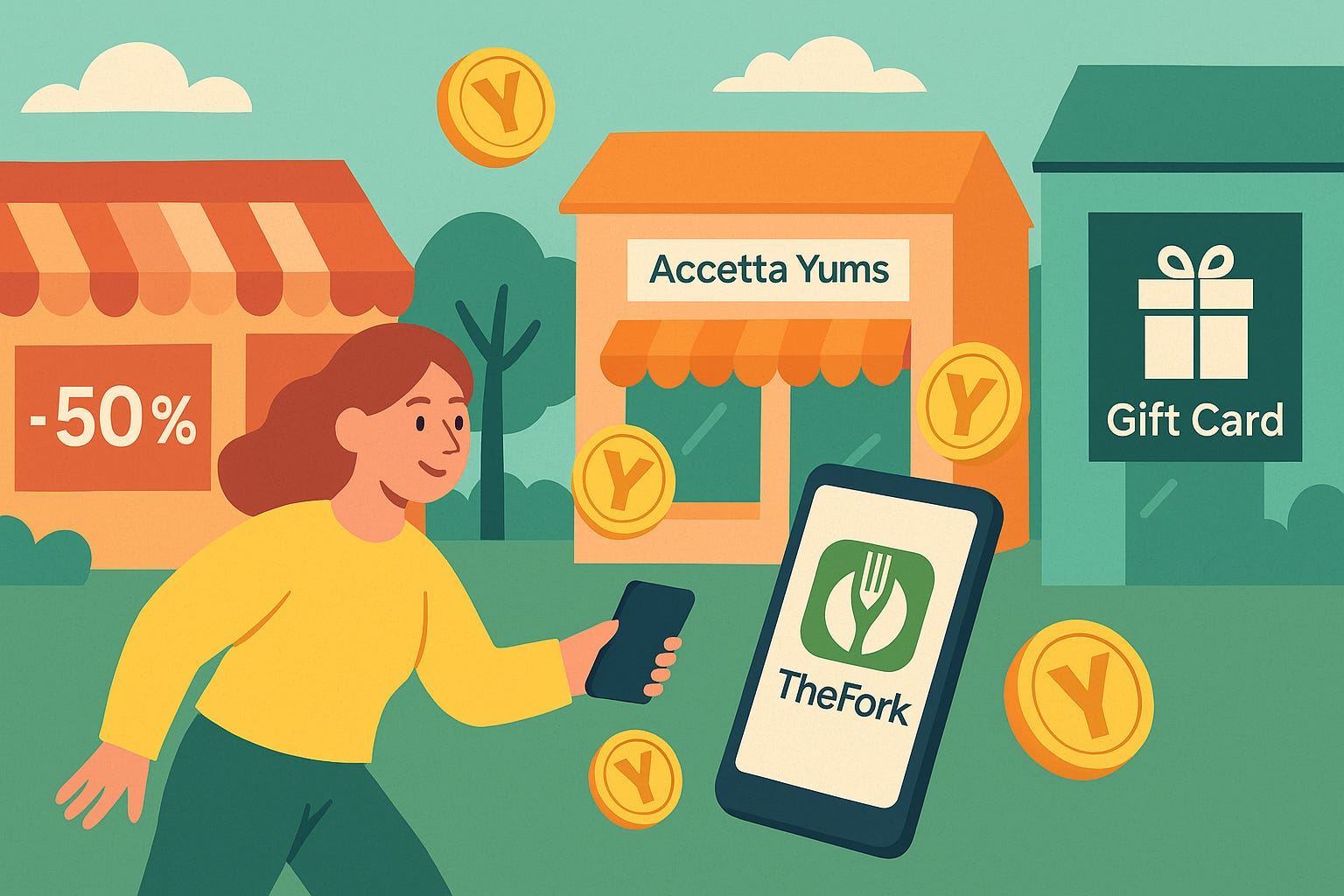
Some restaurants offer discounts when reservations are made through online platforms such as TheFork. The provides discounts between 20% and 50% (excluding drinks and set menus) when booking through the app on a selection of restaurants.
If you plan to eat in restaurants in main cities it can help you to save up considerably and makes it easier to book, since you won’t have to reserve by phone. What you have to do:
register on TheFork website or on the app
at the first booking insert the code 7D3CF799
you’ll get 1000 Yums, equivalent to 20€ of discount to use on your following booking (in selected restaurants)
you’ll earn more TheFork Yums on every booking
If you want to combine discounts, you can purchase a gift card with immediate cashback on Beruby, add it on your TheFork and use the app to pay at the restaurant (TheFork Pay). This will allow you to get an additional 5-10% discount, on top on the discount already provided by TheFork (if available for your choosen restaurant).
Payments in Italy
Most payments in Italy can be made with cards, but understanding a few details can save money.
Credit cards
Visa and Mastercard are widely accepted across the country. American Express may not be accepted in smaller shops.
Cash
Small shops, markets, or cafes sometimes prefer cash for small purchases.
ATM tips
Avoid independent ATM machines in very touristy areas because they often charge higher fees. When withdrawing money, decline the automatic currency conversion and allow your bank to perform the exchange.
To avoid conversion fees, use a Revolut account: create a wallet in Euros, transfer Euros in the wallet during the weekdays (on weekends there’s a conversion fee) and use the virtual or physical debit card to pay online or at shops.
Mobile payments
Contactless payments such as Apple Pay and Google Pay are widely accepted in most shops and restaurants.
Payment apps
Satispay is the most popular payment app in Italy, however it requires a SEPA bank account (mainly European countries), it also requires a few days for completing the registration process.
Avoid tourist traps and scams
Large tourist cities are generally safe, but visitors should be aware of a few common issues.
Pickpockets
Pickpocketing is more common in crowded areas such as public transport, metro stations, and busy squares. Not keeping valueables in bags and avoiding wallets in back pockets reduces the risk. Also don’t leave mobile phones and wallet on tables while eating in restaurant or while resting on the train. Do not leave objects and luggages in a parked car.
Worn discreetly under your clothes, an RFID-blocking neck wallet keeps your passport and cash hidden from physical pickpockets while shielding your cards from digital thieves. S-biners can also be a valueable option, they prevent zippers to be quickly opened by thieves.
Taxi scams
Some unofficial drivers may approach tourists near stations and airports. Always use official taxis with a visible license and meter or taxi apps such as Uber and Free2move.
Restaurant tricks
In some tourist areas, restaurants may add extra items such as bread or bottled water without clearly explaining the cost. Always check the menu and ask if anything is unclear. Ask in advance for the amount of “coperto“, the service and bread fee.
Small tricks that save money
Several small habits can help reduce daily travel costs.
Drinkable public water
Many Italian cities provide public fountains with drinkable water. Bringing a reusable bottle can save money during the day.
Coffee and ice-cream culture
Coffee and ice-cream are cheaper when consumed standing at the bar counter. Sitting at a table may involve an additional service charge.
Transport passes
In cities where you plan to move frequently, daily transport passes are often cheaper than multiple single tickets.
Public toilets
Public toilets are rare, when available in touristic areas are usually not free. A common habit is to use toilets of coffee bars, however you should buy something in order to use the toilet. However, if you visit a museum or a mall, toilets are usually available and free.
VAT refunds
Non-EU visitors can claim VAT refunds on purchases over a certain amount (usually €155).
SIM cards or eSIMs
Local data plans are often cheaper than roaming. Buy a local SIM card at the airport, or (if your phone support it) an eSIM. Airalo is the most famous eSIM provider with dozen of offers and plans for each country.
Travel adapters
If you forget to bring a travel adapter, buying one directly at your hotel can be a costly mistake. To avoid paying double at the reception desk, it is much smarter to pack this Decole universal adapter. Despite its budget-friendly price, it features built-in surge protection and 20W USB ports to charge your smartphone faster than standard hotel wall outlets. Higher-power versions up to 65W are also available for ultra-fast charging, allowing you to leave your bulky phone and laptop chargers at home altogether.
Avoid unnecessary expenses with travel insurance
When planning a trip, underestimating travel insurance is a common mistake that can prove costly. Even a relatively minor issue, such as a medical consultation, lost luggage, or a cancelled flight, can quickly turn into a very expensive headache.
Travel insurance providers are available 24/7, in your own language, and can be useful even if you just need a medical opinion while away.
Among the best value-for-money options, Coverwise is often one of the most affordable: at less than €35 per person for a 2-week trip, it offers higher limits than many competing basic policies (up to €20 million for medical expenses). It also includes coverages that are typically excluded, such as dental care, trip interruption or extension, personal accident/death, personal liability, and legal expenses. Furthermore, it is one of the travel insurance providers with the highest customer ratings on Trustpilot.
Once back: flight delay compensation and passenger rights
When a flight arrives more than 3 hours late, is cancelled, or suffers from overbooking, passengers may be entitled to financial compensation under the European EU261 regulation.
Standard compensation usually ranges from €250 to €600 depending on the flight distance and the final delay at arrival. These protections apply to all intra-European flights, regardless of the airline, but also to flights from outside the EU to Italy or another European country if operated by an EU-based airline. For flights departing from Europe to non-EU destinations, the regulation always applies.
In addition to financial compensation, passengers may also be entitled to assistance such as meals, hotel accommodation, transport, or a full ticket refund in some cases.
In these situations, services like AirHelp can simplify the process significantly. Understanding legal terms and getting your rights recognized by Airline companies is not an easy job. AirHelp checks for free whether a flight is eligible for compensation and handles the entire claim with the airline, charging a fee only if the claim is successful.
AirHelp is widely considered one of the most used and recognized companies in the world for flight compensation claims. In case of delay, always remember to always keep your borading passes, and communication from the airline about the delay/cancellation.
FAQ
Is tipping required in Italy?
No. Tipping is not mandatory. Service is usually included in the bill, and leaving small change is optional.
What is “coperto” in Italian restaurants?
Coperto is a small fee charged per person that covers bread and table service.
Is tap water safe to drink in Italy?
Yes. Tap water is generally safe to drink across the country, and many cities also provide public drinking fountains.
Are pickpockets common in Italy?
They can occur in crowded tourist areas and public transport, but basic precautions usually prevent problems.
Do I need cash in Italy?
Cards are widely accepted, but carrying small amounts of cash can be useful for markets, small cafes, or taxis.
What is the cheapest way to travel between Italian cities?
Regional trains and long-distance buses are usually the most affordable options, especially if booked early.
Are taxis expensive in Italy?
Taxi prices are regulated but can still be relatively high compared with public transport.
Do restaurants charge for bread?
Yes. Bread is often included in the coperto or charged separately.
Are trains and buses on time?
Unfortunately no. It is not infrequent to have delay on trains, including high speed ones. Long distance buses might be delayed due to traffic, especially if they have to cross a border. Transportation strikes are common. Take this into account when planning to move, and make sure you get to your last city a couple of days in advance in order not to miss your return flight.
What are passengers’ rights in case of a delayed or cancelled flight?
Passengers may be entitled to compensation ranging from €250 to €600 in case of delays over 3 hours, cancellations, or overbooking. Eligibility depends on the route and the airline. Services like AirHelp help passengers protect their rights and obtain the appropriate financial compensation.
If you’re planning a trip to Italy, be sure to check out our recommendations for visiting the Cinque Terre:


TuttoCashback.it is a website focused on Italian market that helps people save money every day, offering tips, cashback opportunities, and practical advice for smarter spending.